mare/
mare/Con te con tutto — Italian Pavilion | Biennale Arte 2026
Public Program, communication design and strategy, accessibility project, editorial design
Italian Pavilion | Art Biennial 2026
09.05 – 22.11.2026 | Tese delle Vergini, Arsenale, Venice
Con te con tutto
Commissioner: Angelo Piero Cappello
Curator: Cecilia Canziani
Artist: Chiara Camoni

From 9 May to 22 November 2026, Con te con tutto (With You With Everything) by Chiara Camoni will enliven the spaces of the Italian Pavilion at the 61st International Art Exhibition – La Biennale di Venezia, promoted by the Directorate-General for Contemporary Creativity of the Italian Ministry of Culture. The exhibition, curated by Cecilia Canziani, is a call to come together, an invitation to build a different way of being in the world through encountering and sharing with other lifeforms, leaving room for wonder, sentiment, dialogue, contemplation, and the flow of time that transforms everything.
For the Italian Pavilion at the Biennale Arte 2026, Lungomare brings together design, mediation, and content as an inseparable whole. Lungomare conceives and designs the public program, conceived as an accompaniment to the exhibition, placing at its centre the voice as an expression of presence and transformation, collective making as a shared process, and matter as an active subject of relationships. Lungomare also developed the design and communication strategy, shaping the visual identity and graphic presentation of the Pavilion. Within this framework, an accessibility project has been developed for the first time — not as a supplementary measure, but as a structural component and instrument of mediation within the exhibition. Finally, Lungomare is responsible for the editorial design: an autonomous printed object in which content, form and graphic design work together to extend and deepen the experience of the exhibition beyond its physical boundaries.
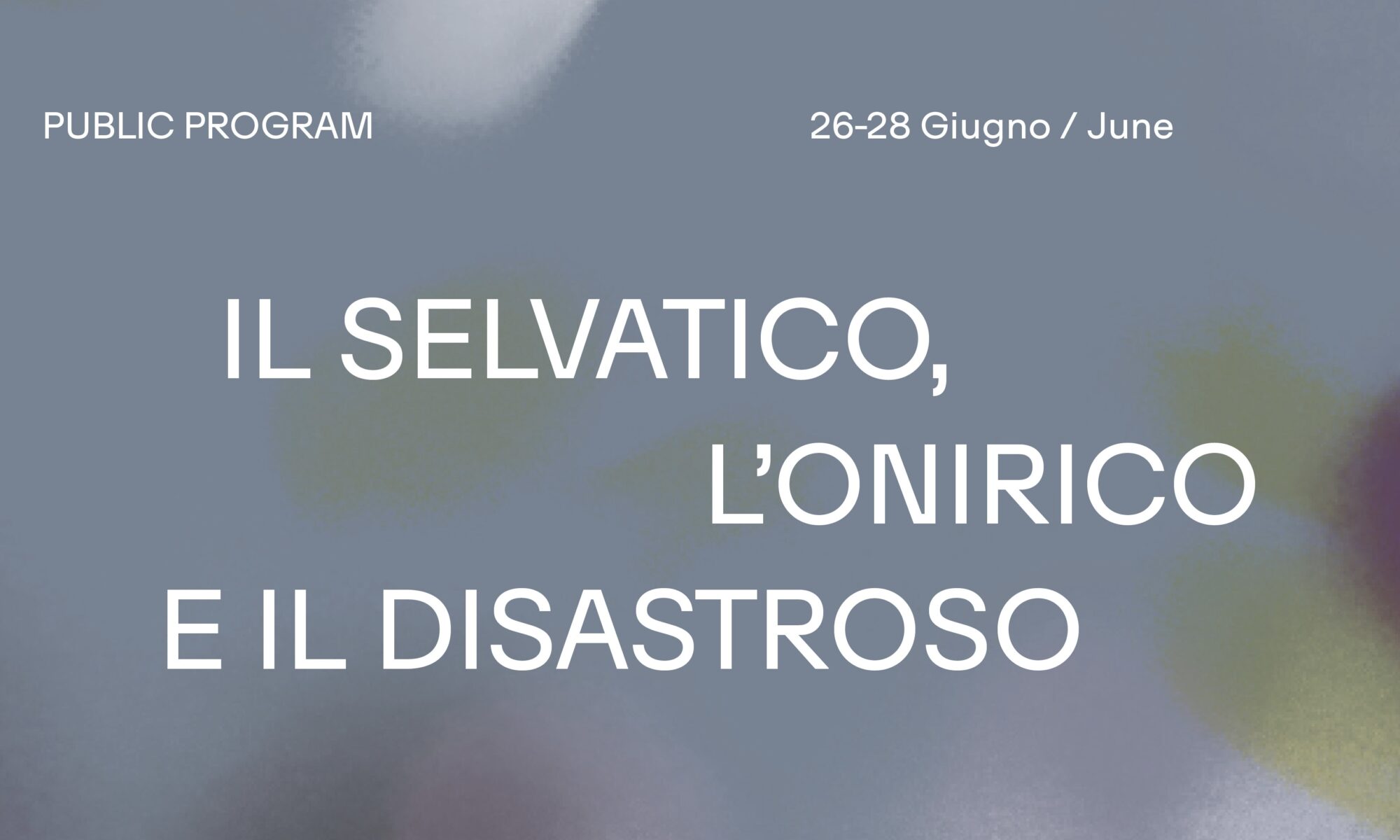
Throughout the exhibition, the Italian Pavilion will be accompanied by a public program conceived and designed by Angelika Burtscher and Daniele Lupo (Lungomare), an invitation to consider the voice as a manifestation of presence, but also as an instrument of dissent and transformation, participating in a shared process in which listening, gesture and words generate connection and reflection. Through performances, processes of co-creation, moments of listening and the sharing of transdisciplinary knowledge, the programme – open to the cultural realities of the city of Venice – triggers direct relationships with Chiara Camoni’s exhibited works, extending their resonance in time and space.


Photo: Giorgio Schirato

Photo: Giorgio Schirato

Photo: Giorgio Schirato

Photo: Giorgio Schirato
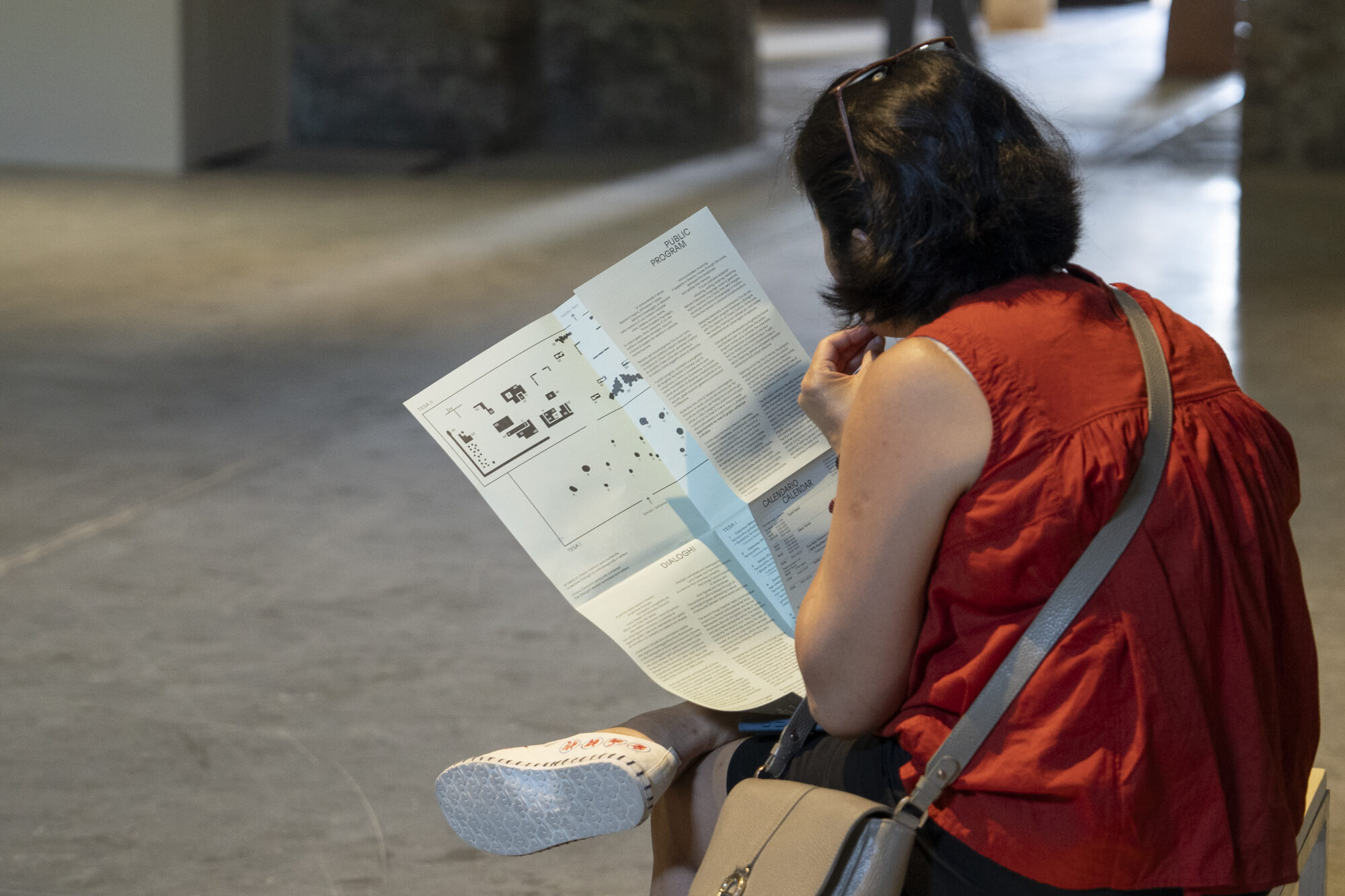


Photo: Giorgio Schirato

Photo: Giorgio Schirato

Photo: Giorgio Schirato

Photo: Giorgio Schirato

Photo: Giorgio Schirato

Photo: Giorgio Schirato

Photo: Giorgio Schirato

Photo: Giorgio Schirato
WEEKEND 1
26 and 28 June 2026
The wild, the oneiric and the disastrous
Tese delle Vergini, Arsenale; Forte Sant’Andrea; Ocean Space
With Giorgio Andreotta Calò, Giorgiomaria Cornelio, Ilaria Gianni, Annalisa Metta, and Roberto Paci Dalò.
In collaboration with Accademia di Belle Arti di Venezia, Arcicoro (Circolo Arci Franca Trentin Baratto), the PhD Programme in Architecture, City and Landscape at Università Roma Tre, Microclima, and NICHE Centre for Environmental Humanities (Università Ca’ Foscari Venezia).
In the first weekend, the public program explores the dream as a generative space in which to develop a new vocabulary for imagining and constructing reality. The voice in the form of poetry and song takes shape as a dialogic and communal practice: individual voices interweave into a collective body. Alongside this perspective is a reflection on landscape as an ambiguous and hybrid entity – not an inert backdrop, but a living presence that questions our ways of looking at what surrounds us. The wild and the hybrid emerge as productive categories for thinking about the cities and natures we inhabit.
WEEKEND 2
25 and 26 September 2026
The many forms of knowing
Tese delle Vergini, Arsenale
With Angelika Burtscher, Cecilia Canziani, Felice Cimatti, Valentina Karga, Esther Kinsky, Daniele Lupo, Jacopo Miliani, and NERO with Cora Baratti and Giulia Currà (Salotto delle Preziose).
In collaboration with Staatliche Hochschule für Gestaltung (HfG) Karlsruhe and Università Iuav di Venezia — Multimedia Arts Programme.
The second weekend proposes a return to myth, ritual, archaic knowledge and beyond-human intelligence as alternative forms of knowing. A polyphony of knowledge that moves through voice, bodies and matter, opening spaces of resistance to univocal and authoritarian narratives. Within this horizon, knowledge is understood as a device capable of opening counterintuitive perspectives and of calling into question what appears obvious – a decentring of reason in order to know the world from multiple angles.
WEEKEND 3
29, 30 and 31 October
What the voice carries
Tese delle Vergini, Arsenale
With Mirene Arsanios, Sara Basta, Adriana Cavarero, Cecilia Canziani, Felice Cimatti, Wissal Houbabi, and Francesco Ventrella.
In collaboration with Accademia di Belle Arti di Venezia and Accademia di Belle Arti di Roma; NABA, Nuova Accademia di Belle Arti, Rome campus; and Spazio Punch.
The third and final weekend of the public program explores the voice as bodily manifestation and creation of communal space, as an instrument of memory beyond linguistic and cultural borders. The voice is never neutral nor universal, but singular and relational: it exposes the uniqueness of the speaker and calls upon the listening of the other. The programme investigates how historical vocal practices and memories are transmitted through time, becoming new collective narrative – the voices of the past tune in with those of the present, carried by those who inhabit the diaspora. Alongside this experience comes an open invitation to the city: to translate into words the voices of the present, to pass them from body to body toward the future.
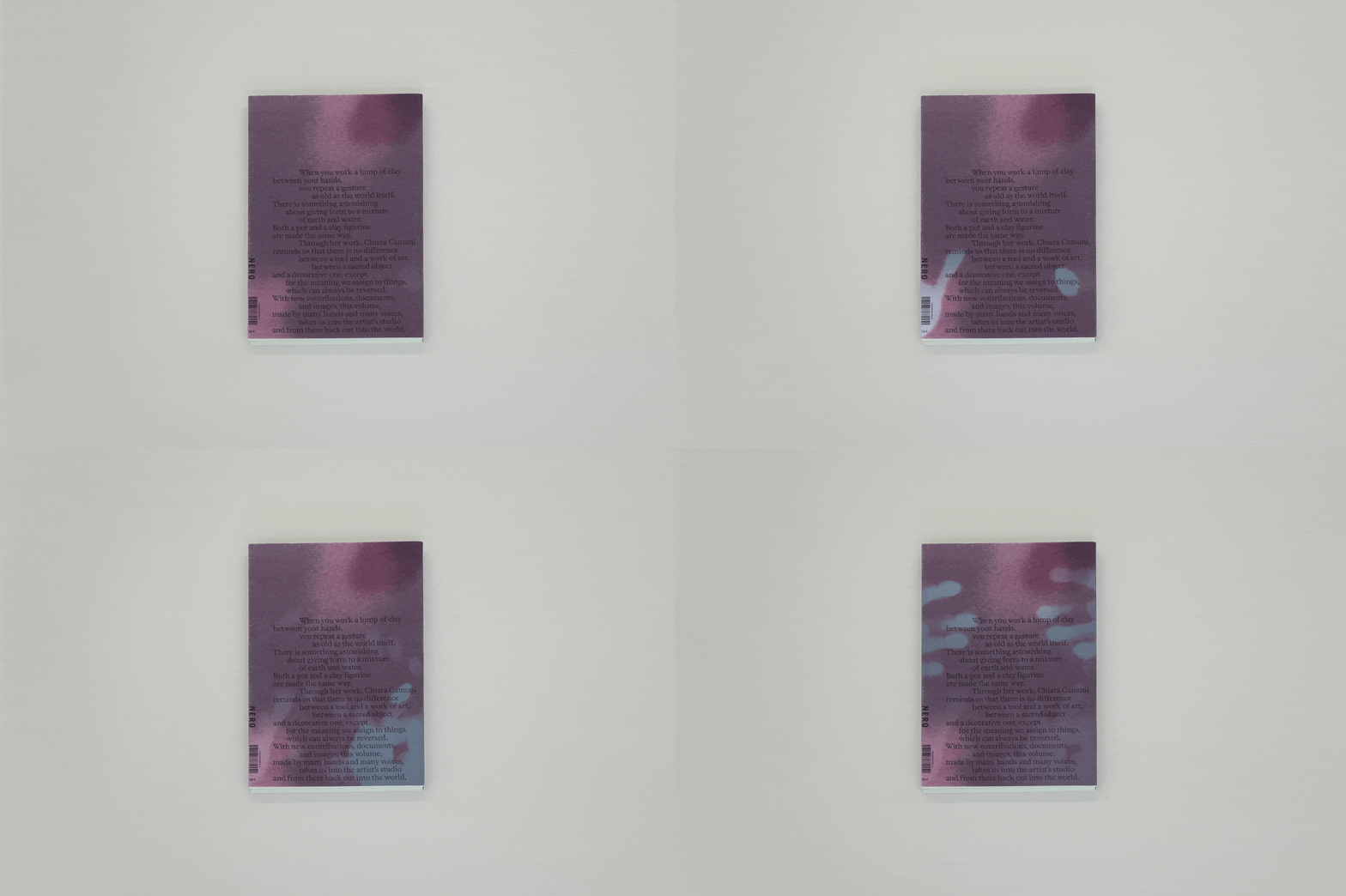
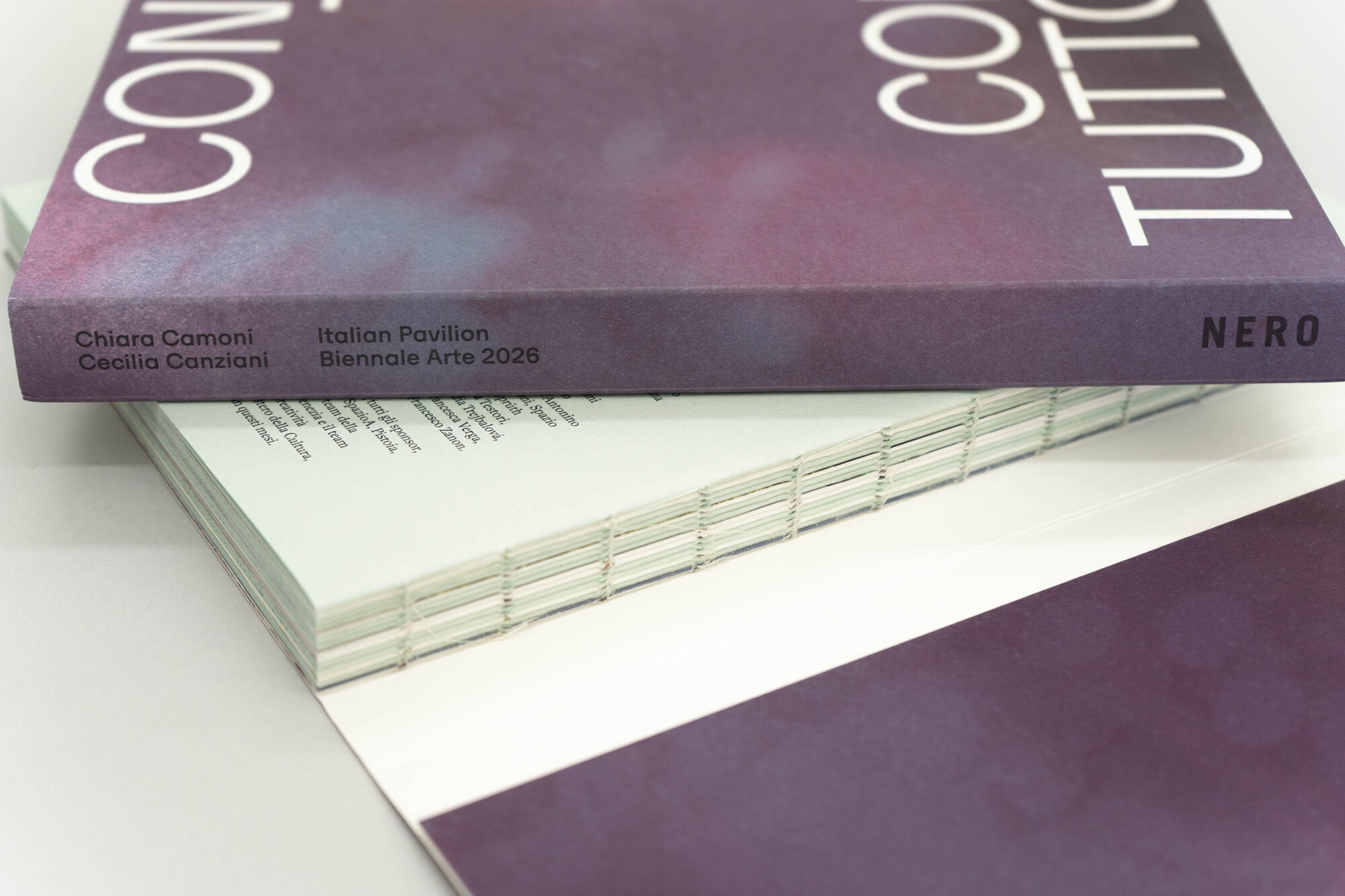
The exhibition at the Italian Pavilion as part of the 2026 Art Biennale is accompanied by the publication of a catalogue with the graphic design by Lungomare, produced by the publishing house NERO Editions and with the contribution of the entire Pavilion’s working team.

The volume is conceived as an anthology made up of images and texts that alternate freely, showing the contiguity of themes, evocations and ideas that circulate in the artist’s practice and throughout the exhibition. This alternation is also translated visually through a continuous change of paper stock between sections printed on textured turquoise natural paper and sections on smooth, glossy white paper. Like the exhibition, the volume is conceived as a polyphony, capable of conveying the experience of the Pavilion through the many voices of which it is made up. The layout is also structured through two main grids, interrupted by a horizontal line that marks the Dialogues section, extending from one margin of the book to the other. The sequence of photographic images, on the other hand, unfolds as a dialogue between images of artworks, exhibition views, and what the artist defines as “matter”: fragments of images that contributed to the creation of the works themselves. In this way, the images are freely arranged throughout the book, while always starting from the centre and moving outwards.
The volume is designed as a pocket-sized book that can be easily carried and consulted during and after the visit. A user’s manual, designed as a space for writing and taking notes in the margins. The cover is also independent from the book block: it is not glued, but rather rests on it and contains it. The design of the cover welcomes the traces left by each reader through the use of thermochromic paint, which reacts to heat. The gestures that each of us leaves behind are added to those of the artist and of everyone who contributed to the catalogue.
A book that transforms not only in relation to the environment in which it is placed, but also through the hands it passes through.
The catalogue features essays commissioned for the occasion from Esther Kinsky (writer), Lisa Le Feuvre (director of the Smithson-Holt Foundation, USA), Annalisa Metta (full professor of Landscape Architecture at Roma Tre University), Laura Tripaldi (researcher, Centre for AI & Culture, New York University, Shanghai), Francesco Ventrella (associate professor of Art History, University of Sussex) and Chiara Zamboni (philosopher), an introductory text to the exhibition by Cecilia Canziani, Fiammetta Griccioli and Lucia Aspesi (Dialoghi), and by Angelika Burtscher and Daniele Lupo (Public Programme).
These are interspersed with images documenting the exhibition, the artist’s own working process, life in her studio, the material and the suggestions that together form part of the works, and an anthology of republished texts, translated for the first time, occasional writings, fragments of poetry extracted from the Public Programme, notes, reflections, snapshots and a selection of texts by the artist which, taken together, convey the essence of the research and working methods that characterise Con te con tutto.
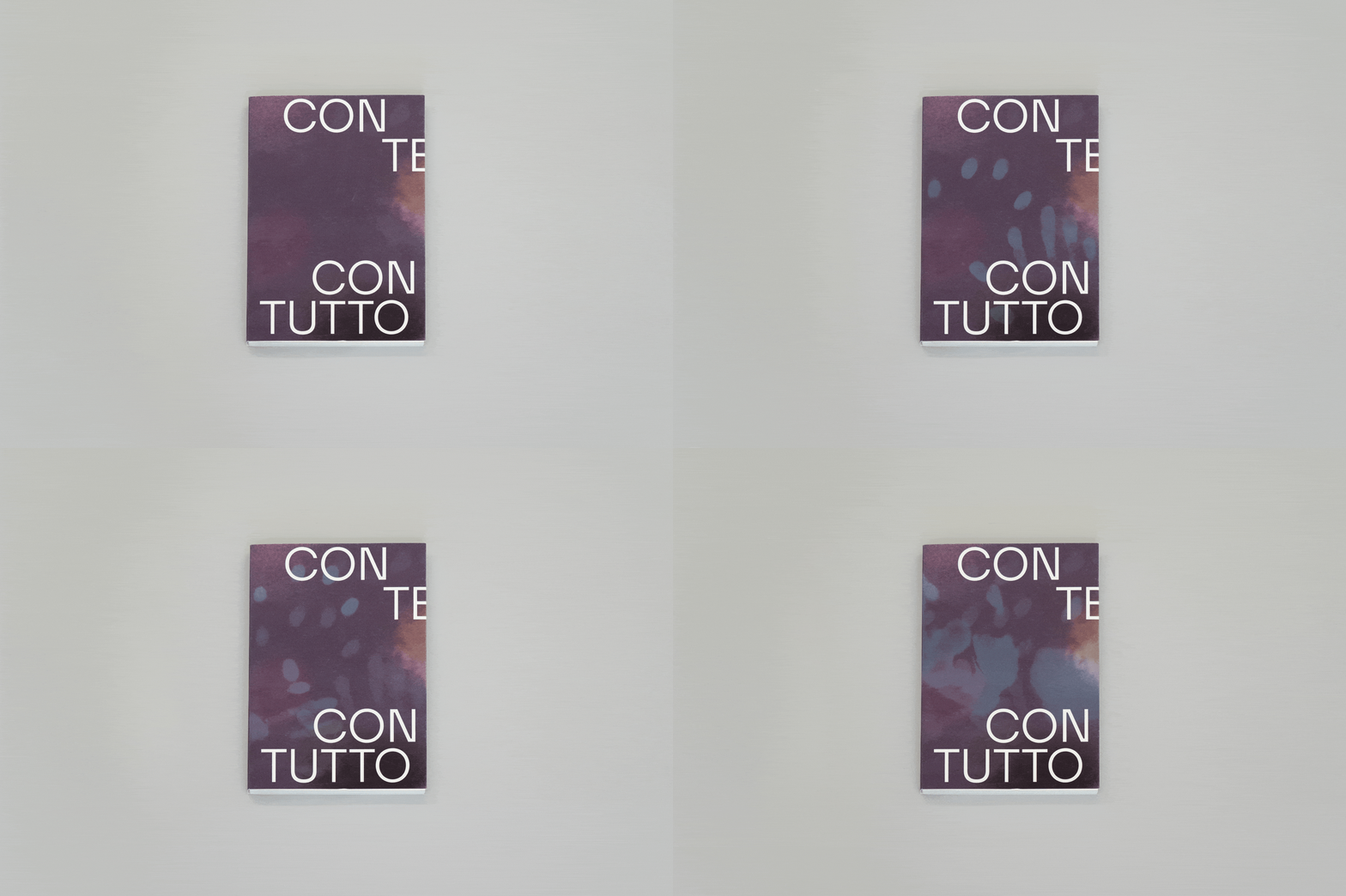
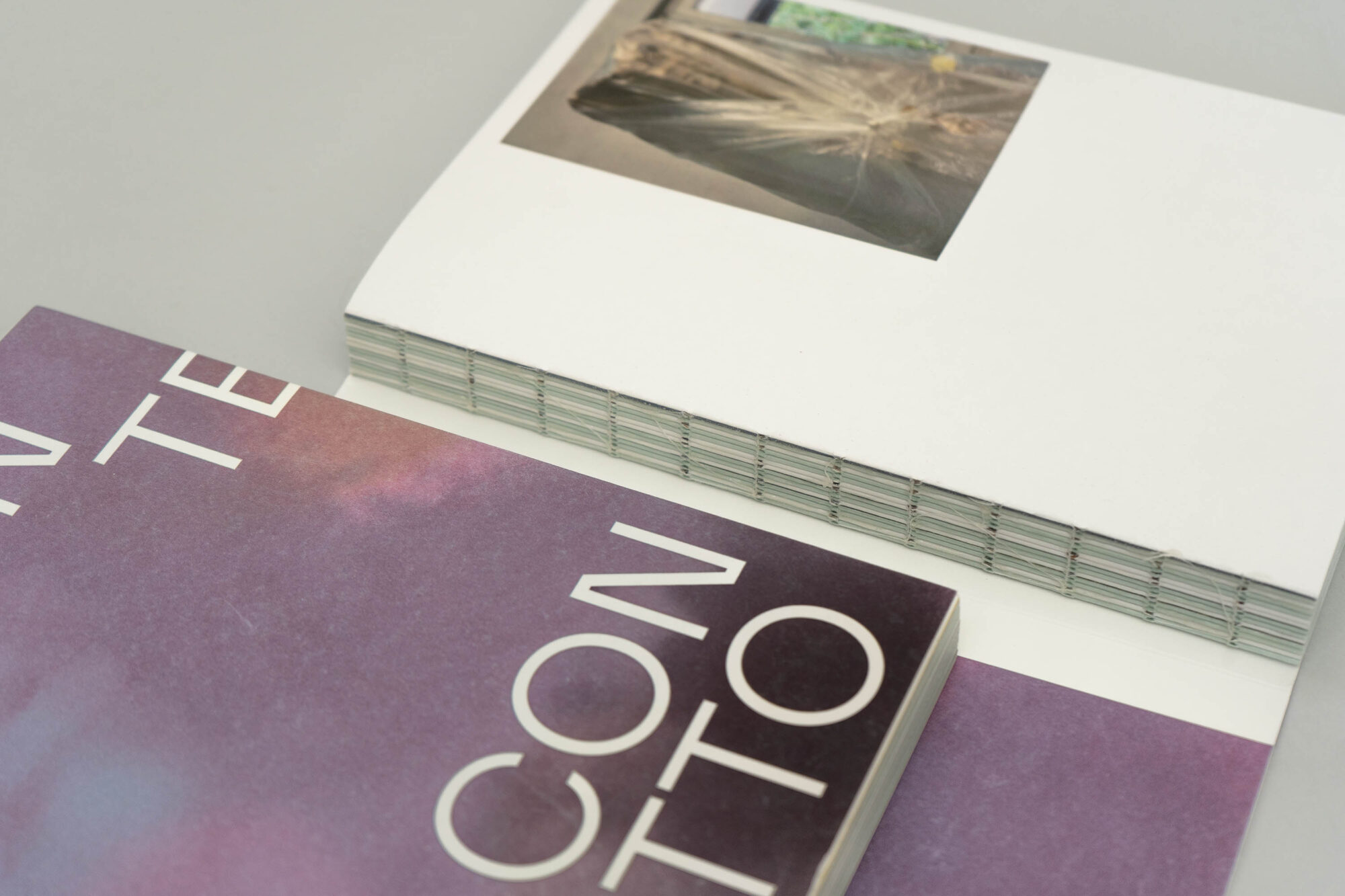
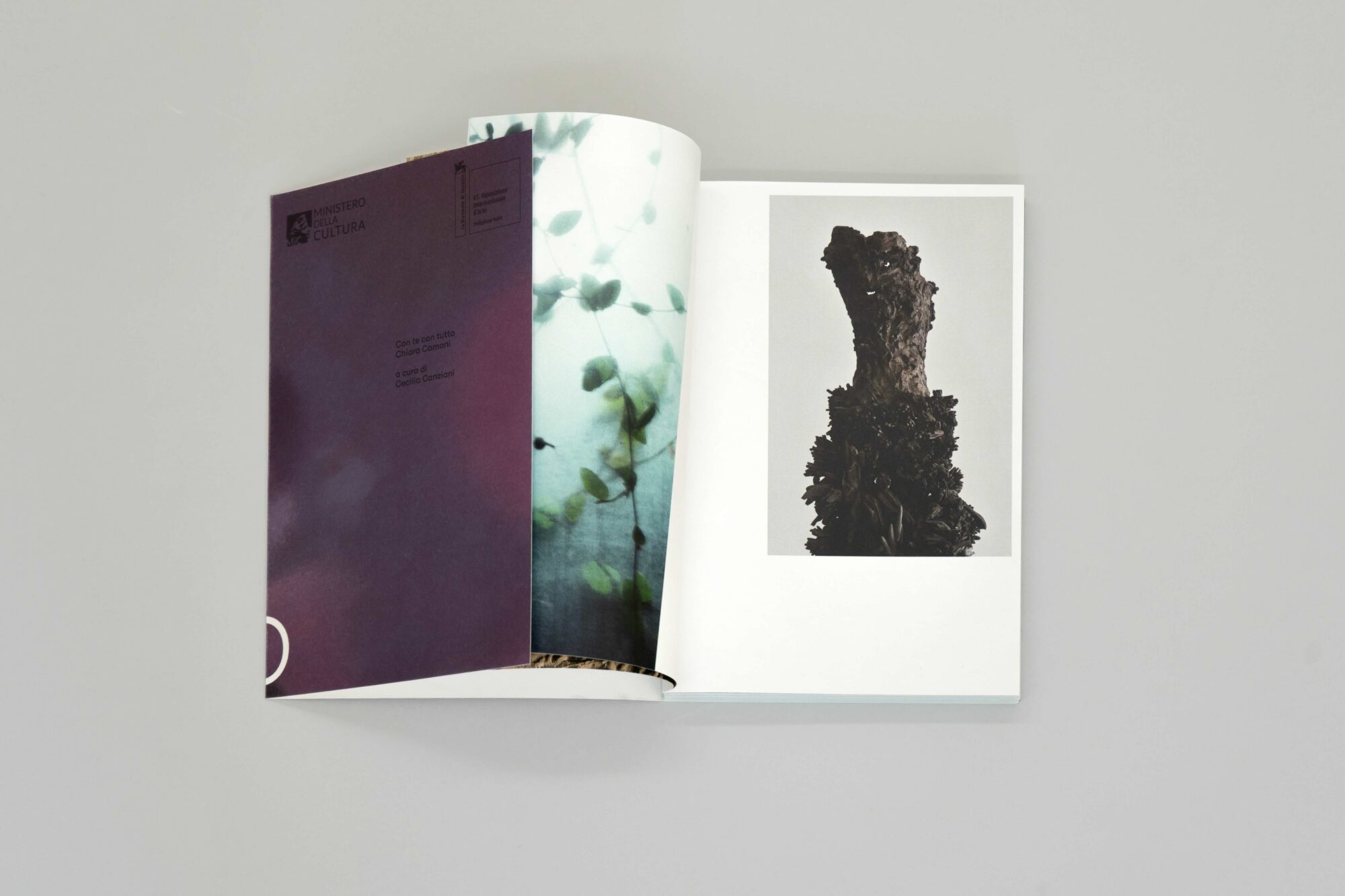
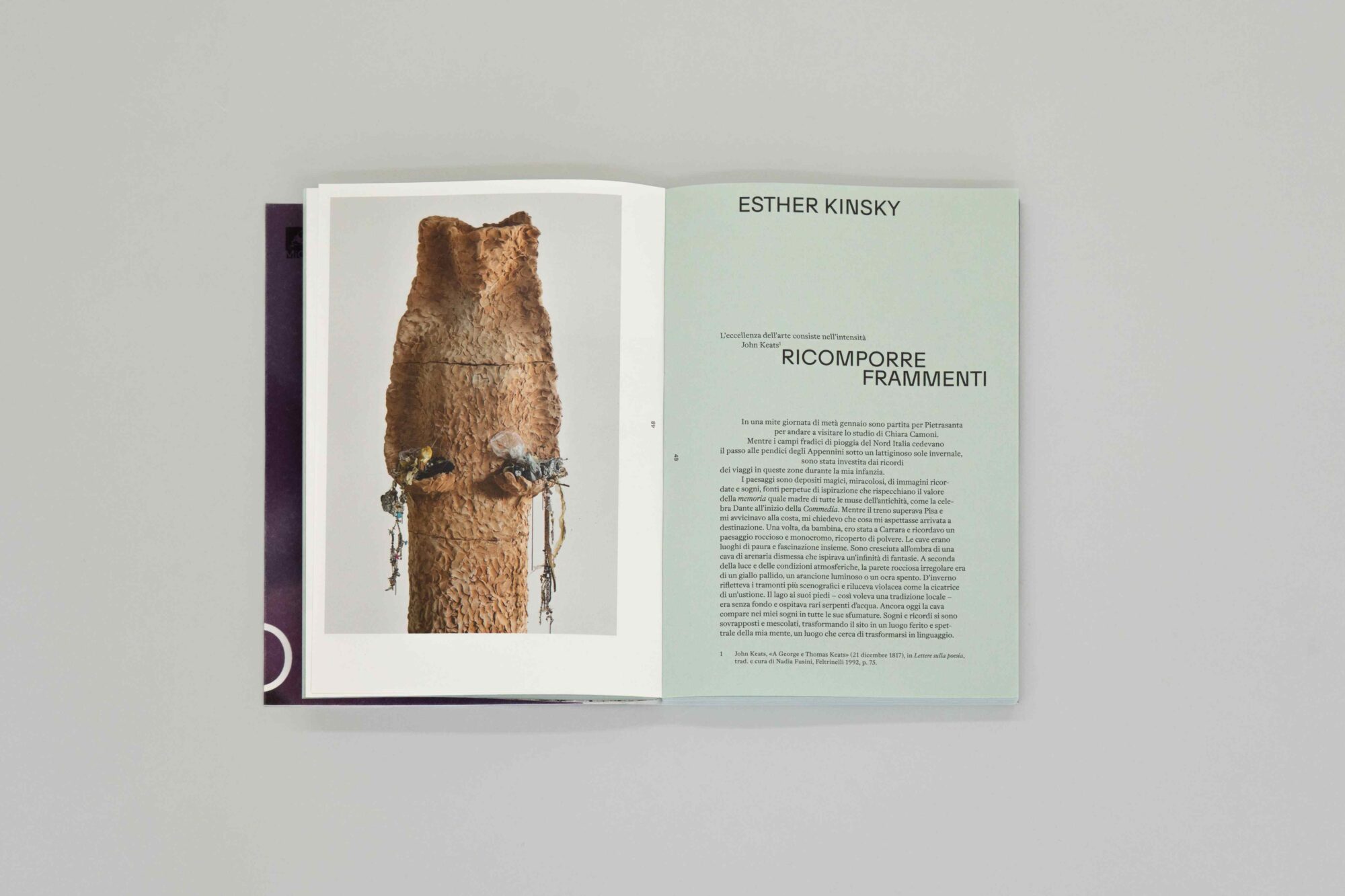
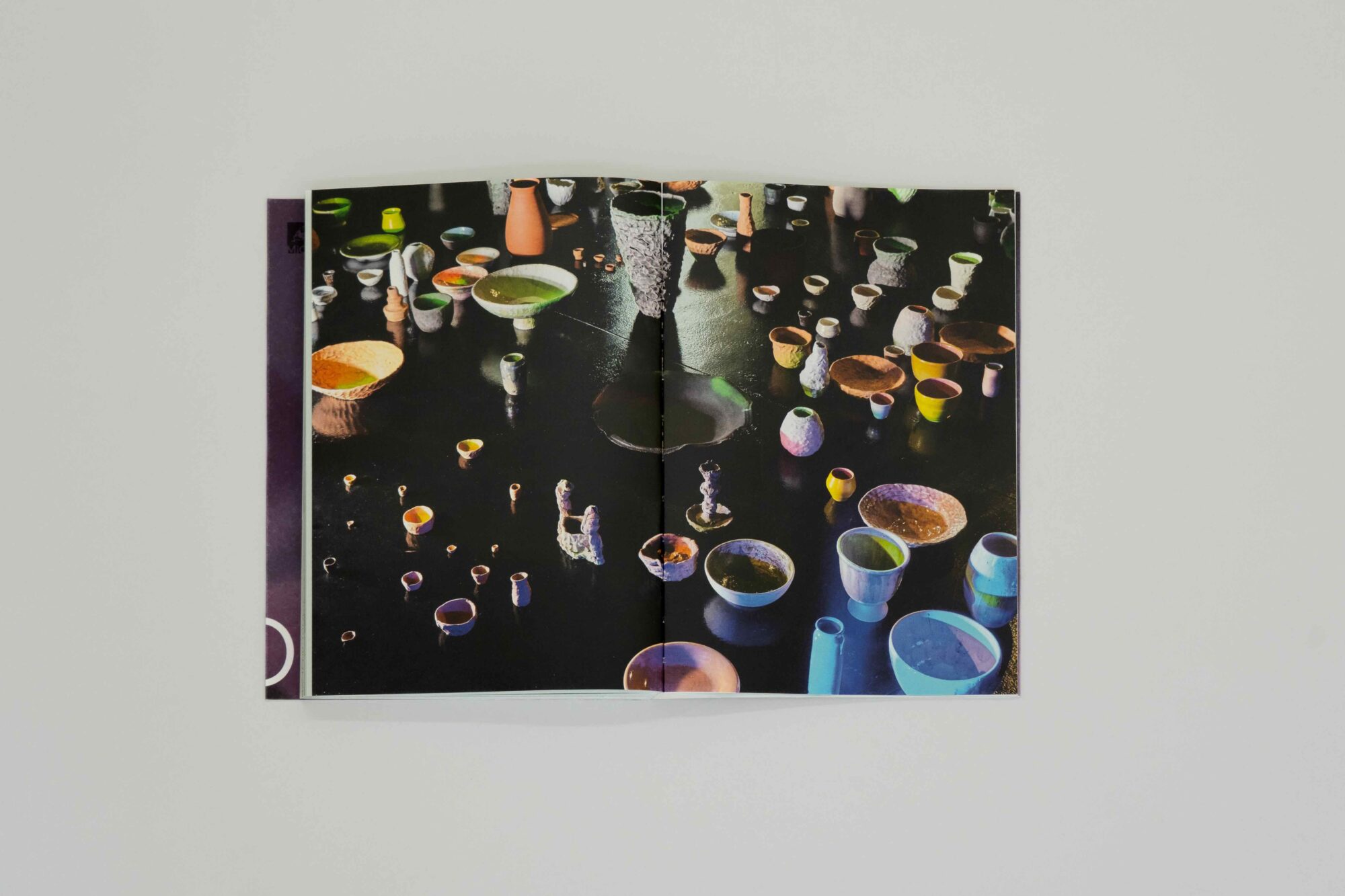
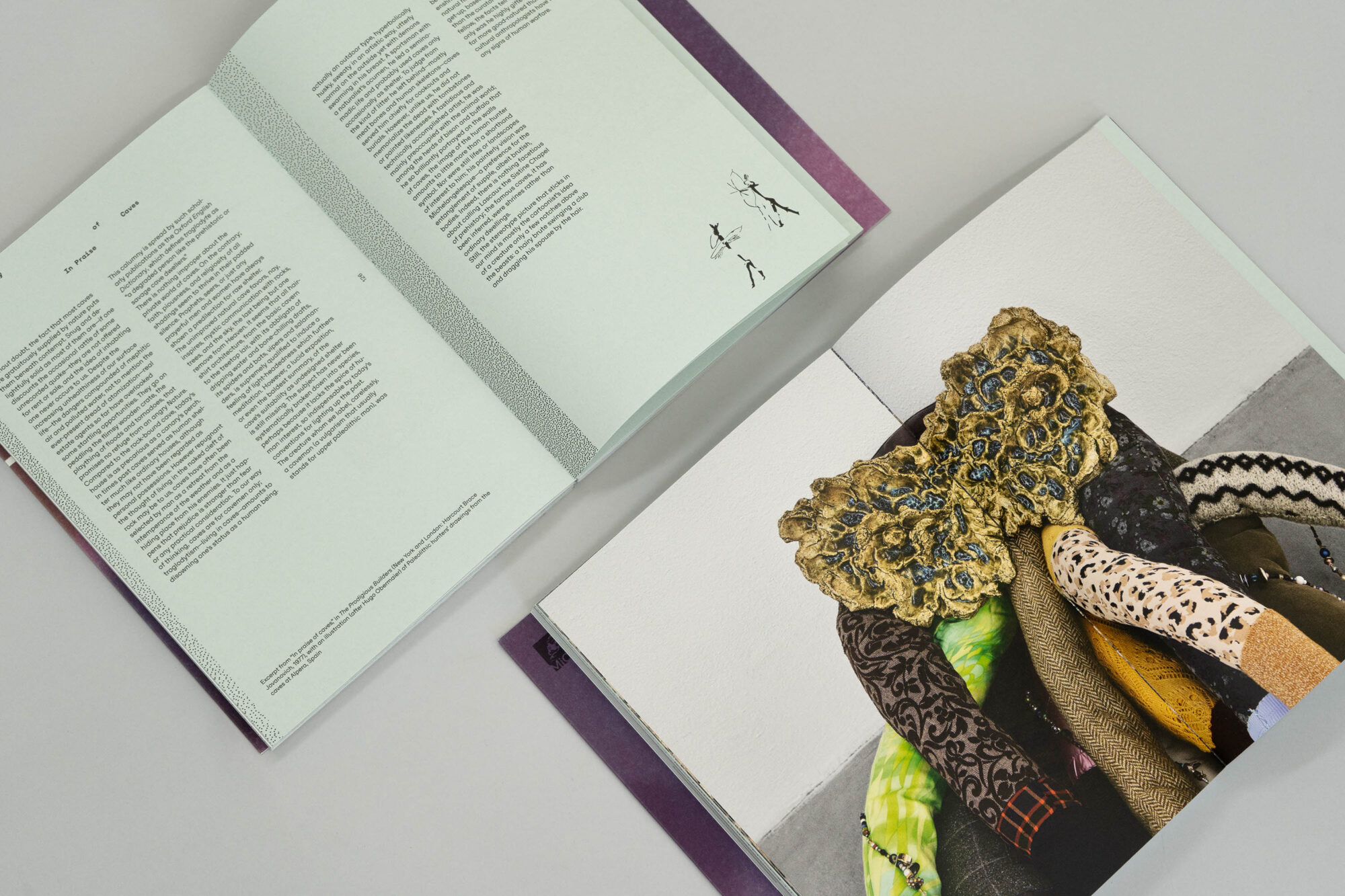
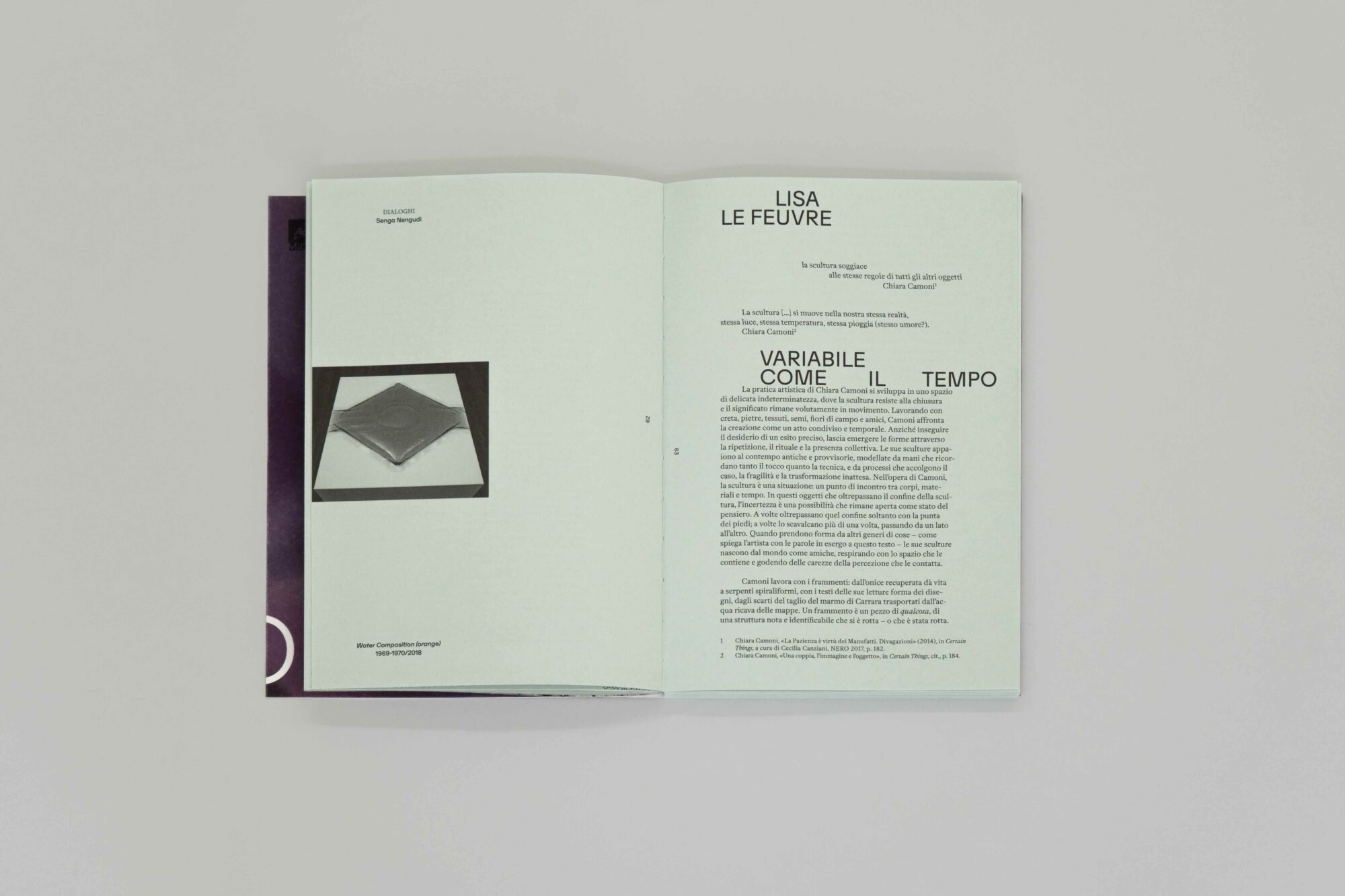
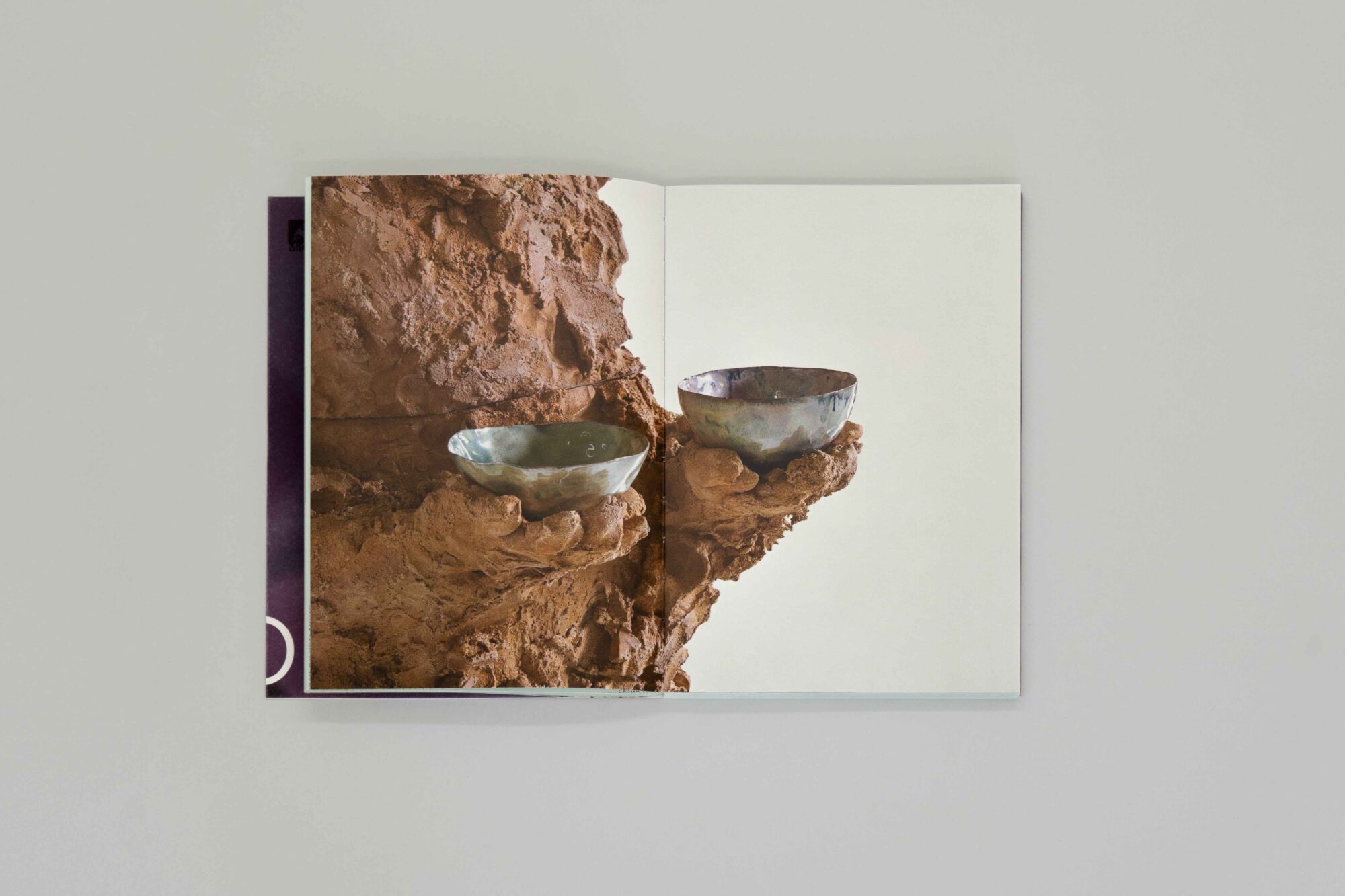
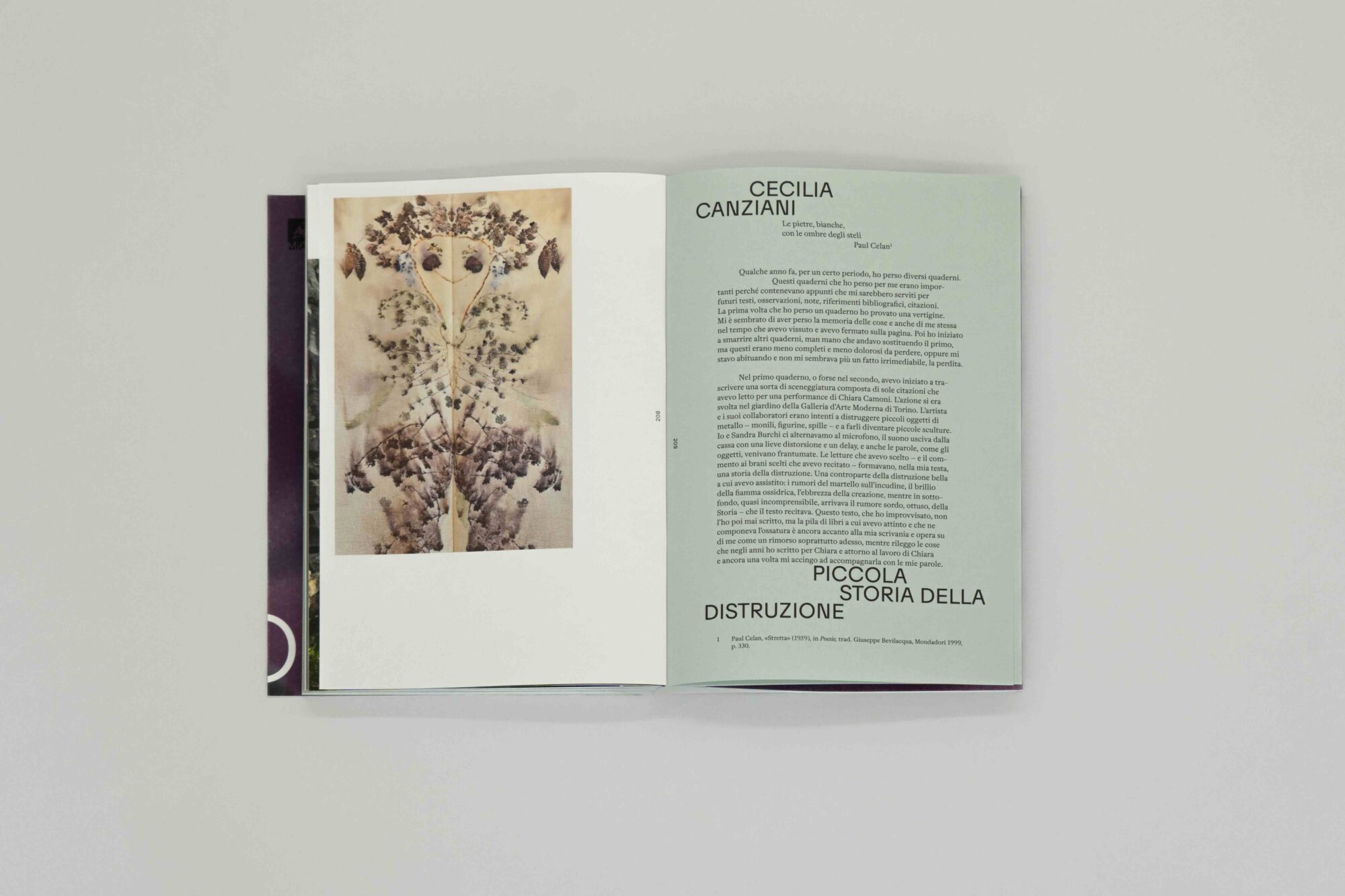
Lungomare conceived and developed the visual identity for the Italian Pavilion at the 2026 Venice Biennale Arte. The project’s concept revolves around the exhibition title Con te con tutto, which also serves as the logotype. This double pairing is defined by its readability and flexibility, but above all by its ability to recreate spaces for encounter within its own boundaries.


Photo: Giorgio Schirato
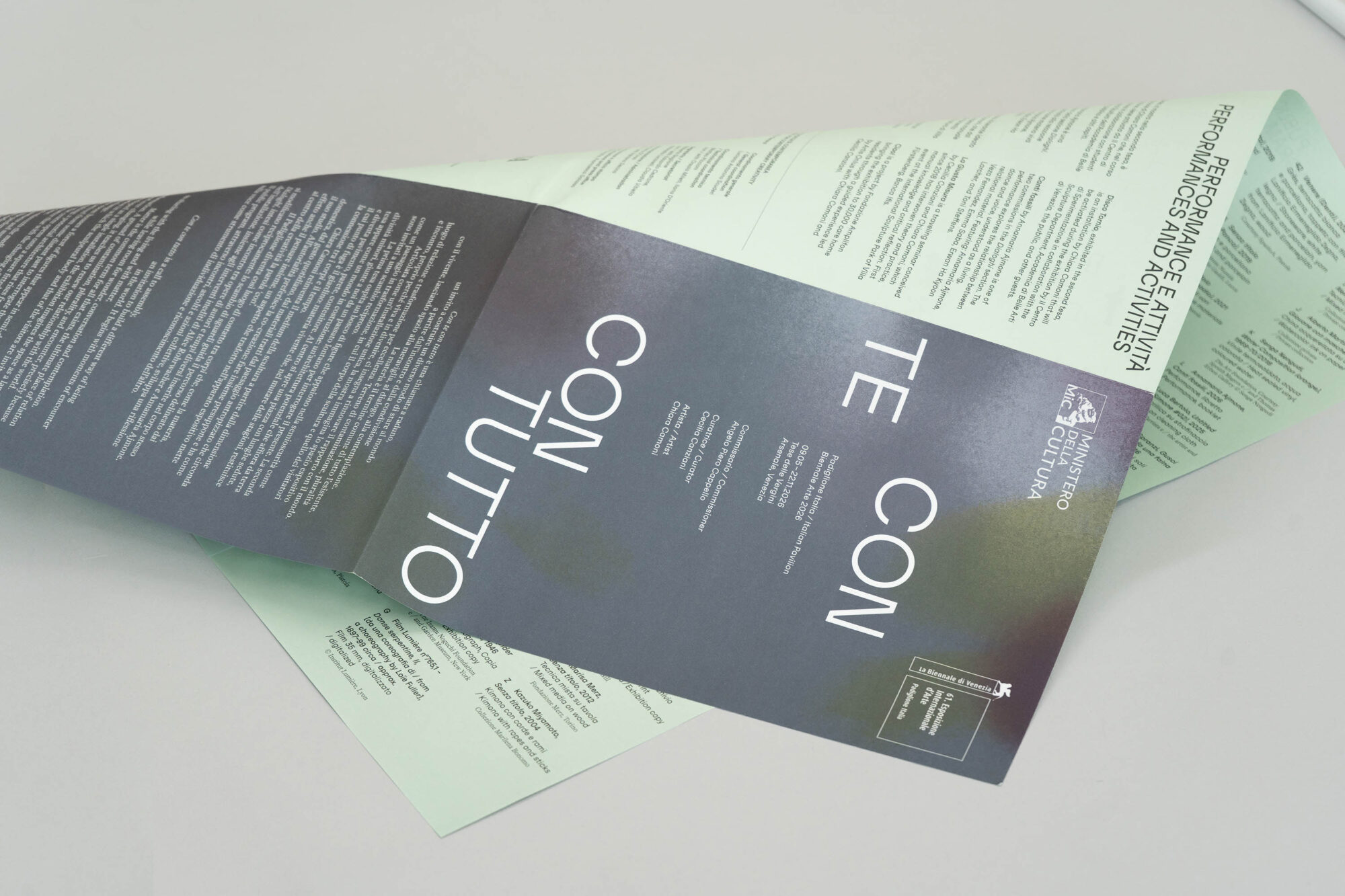
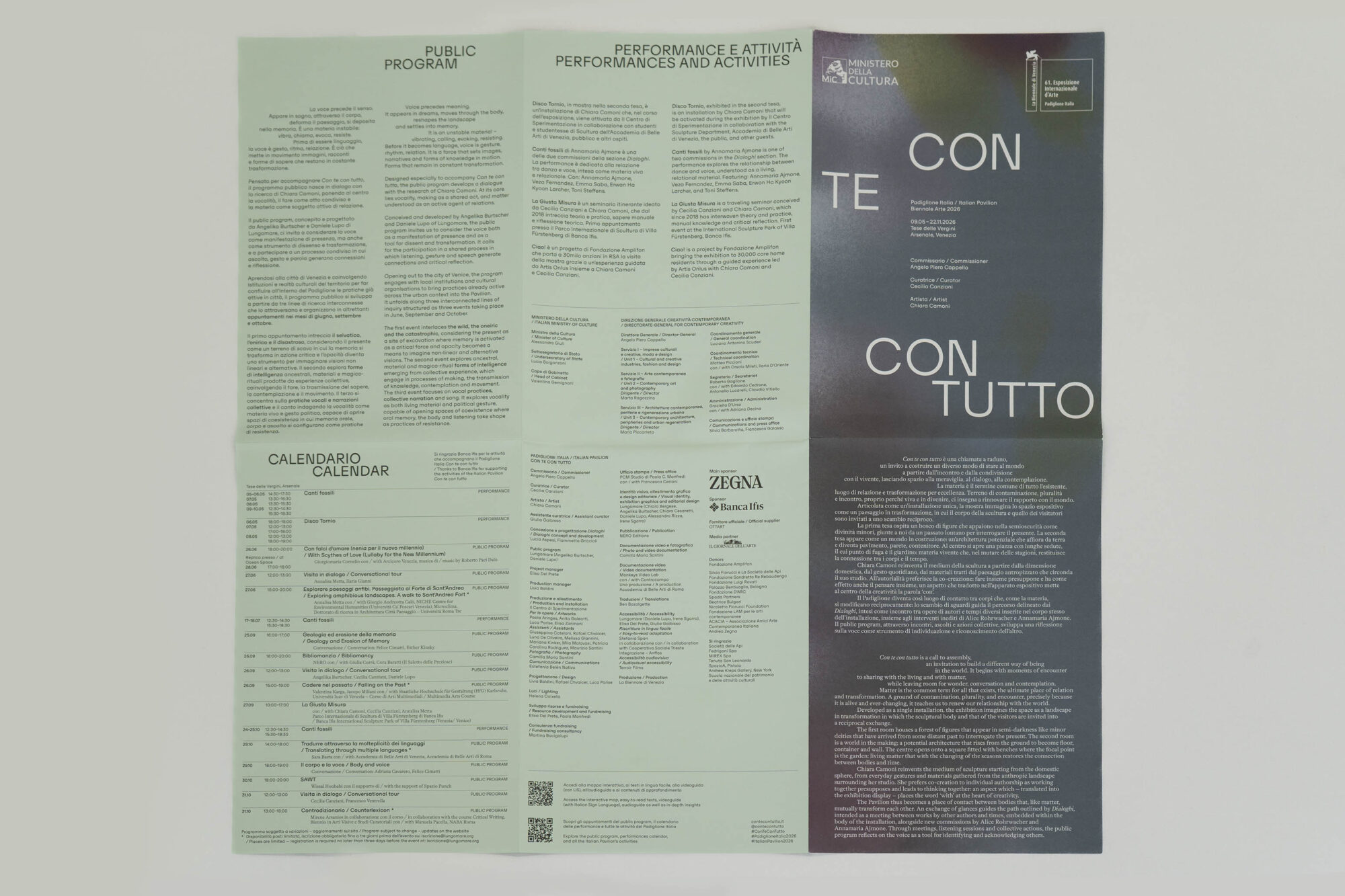
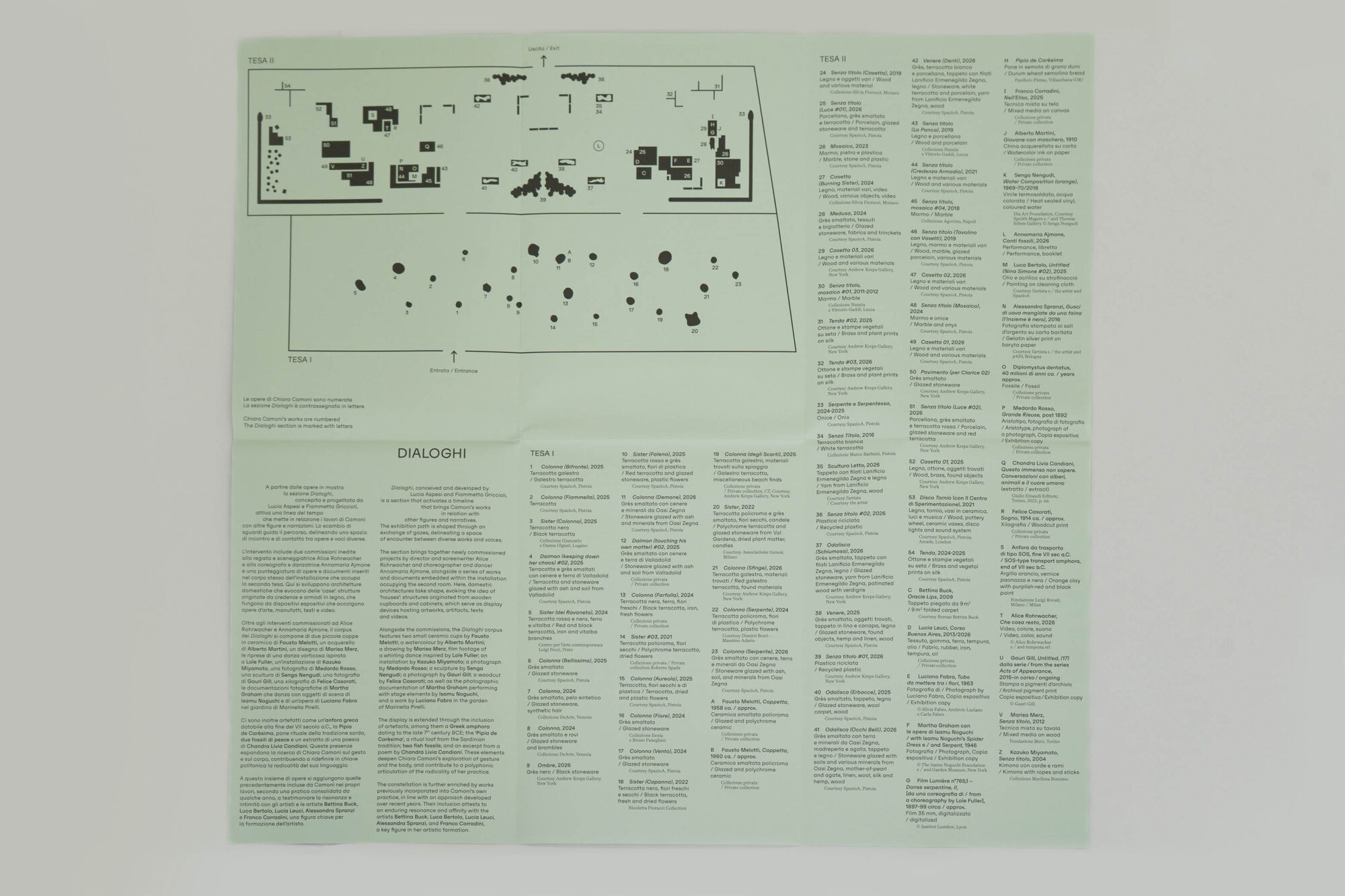
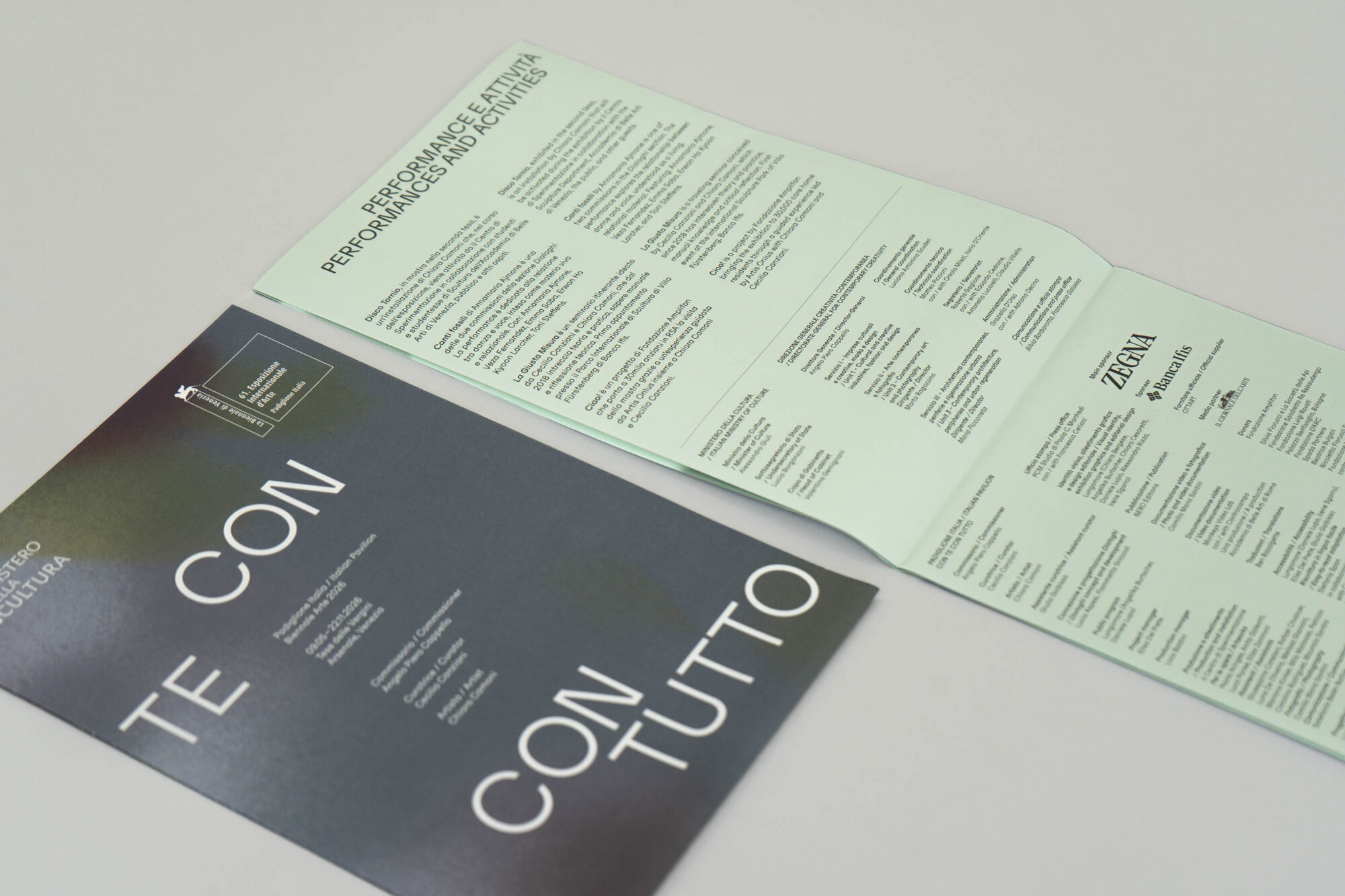
In large-scale formats — posters, banners, and public space applications — the title expands until it takes on a sculptural presence; in digital and dynamic formats, the logotype becomes more agile and lightweight, eventually transforming into movement. The logotype is conceived as a dynamic and relational space, entering into dialogue with the elements surrounding it, in line with the nature of the proposed exhibition project.
The project’s typographic choice is based on two typefaces: a primary one, used for the logotype and for the texts contextualising the work of artist Chiara Camoni, and a secondary one, dedicated to the texts of the other voices involved in the project and to more narrative connective elements. In the visual materials, the texts are in a subtle and constant movement, renewing themselves at the rhythm of a slow and attentive step.
The visual layer forming the background to the informational and typographic elements draws on the theme of gesture and traces, collected through a collective action involving the entire pavilion working group. Furthermore, the visuals evoke the theme of matter through the chromatic choices of the backgrounds developed for the various communication tools: they are inspired by shifting material patterns — earth, fire, water — and by the grey-brown tone recurring throughout the artworks. As the sum of all colours and shades, grey-brown resists a clear interpretation, becoming instead a mirror of a vibration in which all the elements composing it can be recognised. These elements are also permeated by movement, like lights shifting to make room for ever-changing relationships.
A project promoted by the Directorate-General for Contemporary Creativity of the Italian Ministry of Culture
For further information:
www.contecontutto.it
www.creativitacontemporanea.cultura.gov.it
Year
2026 – ongoing
Commissioned by
Angelo Piero Cappello
Curated by
Cecilia Canziani
Artist
Chiara Camoni
Assistant curator
Giulia Gaibisso
Dialoghi Concept and Design
Lucia Aspesi, Fiammetta Griccioli
With the participation of
Annamaria Ajmone, Alice Rohrwacher
Public Program
Lungomare (Angelika Burtscher, Daniele Lupo)
Project Manager
Elisa Del Prete
Production Manager
Livia Baldini
Communication and social media strategy
Elisa Del Prete, Giulia Gabisso
Press Office
PCM Studio by Paola C. Manfredi, Francesca Ceriani, Chiara Piantavigna
Visual identity and graphic design
Lungomare (Chiara Bergese, Angelika Burtscher, Chiara Cesaretti, Daniele Lupo, Irene Sgarro, Alessandro Rizza
Editorial design
Lungomare (Angelika Burtscher, Chiara Cesaretti)
Design
Luca Parise, Livia Baldini, Rafael Chvaicer
Lighting
Helena Caixeta
Production and staging
Il Centro di Sperimentazione
Setup and production of works
Elisa Anioni, Luca Parise, Paola Aringhe, Anita Galeotti
Photography
Camilla Maria Santini
Communications
Estefania Belen Nativo
Assistants
Patricia Carolina Rodriguez, Maurizio Santini, Melissa Giannini, Mariana Kinker, Mila Malavasi, Luna De Oliveira, Giuseppina Catelani
Publication
NERO Editions
Photo and video documentation
Camila Maria Santini
Video Documentation
Monkeys video lab, Alessio Rucchetta, Valerio Sammartini, Simone Nazzareno Valente
Translations
Ben Bazalgette
Production
La Biennale di Venezia